Roof Repairs
Leak and tile repairs from Glenbrook to Mount Victoria, where moss on shaded pitches and frost-damaged pointing cause most failures.
Learn more →Full re-roofing across the Blue Mountains in tile or Colorbond steel, specified for steep pitches, heritage streets and bushfire-prone blocks.
Leak and tile repairs from Glenbrook to Mount Victoria, where moss on shaded pitches and frost-damaged pointing cause most failures.
Learn more →Colorbond roofing across the mountains, with non-combustible detailing for homes on bushfire-prone land.
Learn more →Restoration suits mountain tile roofs better than most: stripping moss and lichen, rebedding ridges and recoating so the roof sheds water again.
Learn more →Gutter replacement and ember guard for Blue Mountains properties, where leaf litter and ember entry are the same problem.
Learn more →Emergency response across the mountains after heavy rain, hail or wind, starting with a make-safe the same day.
Learn more →Roof inspections and written reports for mountain homes, including pre-purchase checks and insurance documentation.
Learn more →A re-roof is the right call in three situations. The battens, sarking or valley boards underneath have failed, so there is nothing sound to fix to. The roof has been patched repeatedly in the same places and the patches have stopped holding. Or the covering itself has reached the end of its service life — crazed and porous terracotta, concrete tiles that are shedding their surface in sheets, or old corrugated steel that has corroded through at the laps and fixings.
What a re-roof is not is the answer to a roof that merely looks bad. Moss on a southern pitch, a faded coating and crumbled ridge pointing all look alarming and are usually a roof restoration job at a fraction of the cost. We would rather send you down that road if that is what the roof needs.
Call (02) 4703 5000 for a look and a written quote. Nothing to pay for either.
The covering is the visible part and the smallest part of the decision. Stripping back to the frame is what makes the job worth doing, because it is the only time anyone gets to see and fix the layers underneath:
Both work here. The deciding factors are usually the house, the block and the planning constraints rather than any general rule.
Concrete or terracotta tile suits the mid-century and later brick-veneer stock through Blaxland, Springwood and Winmalee, and it is the like-for-like option on a tiled heritage roof. The trade-off is that every tiled roof up here has bedded ridge caps, and bedded mortar is exactly what freeze-thaw cycling attacks. Plan on repointing being part of the maintenance cycle.
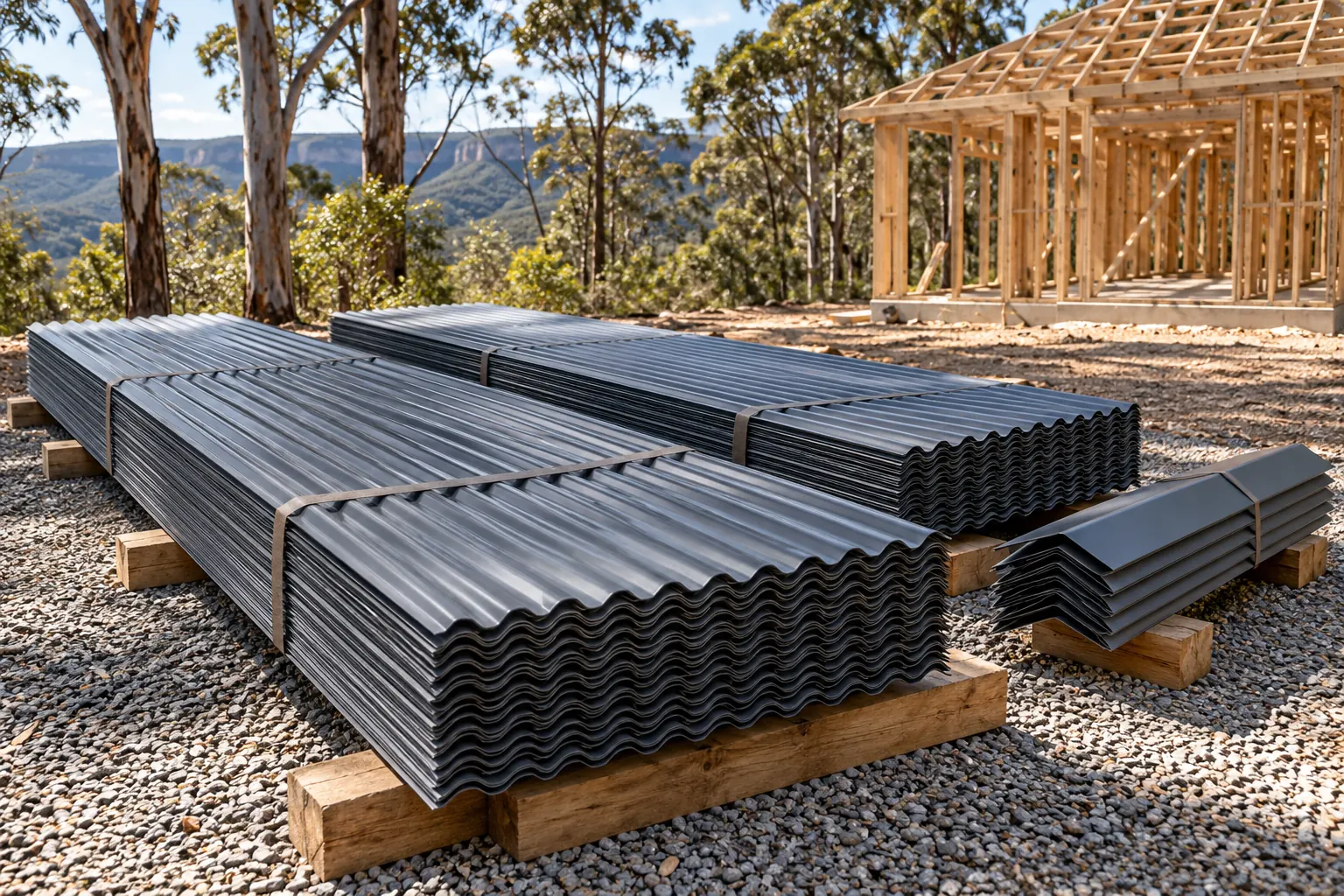
Colorbond steel has real advantages on a steep mountain pitch: lighter on the frame, no ridge mortar to break down, it sheds leaf litter and snow faster, and it is non-combustible, which simplifies the bushfire detailing. Short-run corrugated reads correctly on a weatherboard cottage or a Federation roofline. Our metal and Colorbond roofing page goes further into profiles and fixings.
The one thing a steel roof needs that a tile roof does not is proper condensation control. A cold steel roof over a warm, humid interior will sweat on the underside on a frosty night, so sarking with an anti-condensation layer and real ceiling-space ventilation are part of the specification, not an extra.
Heritage. Katoomba, Leura and Mount Victoria carry conservation areas — Katoomba South, Crown Village, Grimley Estate, Norths Estate, Leura North and Leura South among them — plus individual heritage items such as the 1849 Toll House and the surviving Federation guesthouse stock. Material, profile and colour are all in scope.
Bushfire. With roughly 70% of the local government area inside Blue Mountains National Park, most blocks here sit on mapped bush fire prone land. Where a BAL applies, AS 3959 drives the roof detail: full sarking, sealed roof-wall junctions, non-combustible ember guards at openings, metal or uPVC gutters, box gutters non-combustible and fully flashed. Your Section 10.7 certificate and a BAL assessment are what confirm the level for your property.
Where the two overlap — a heritage cottage on a bush-interface block at Medlow Bath, say — the specification has to satisfy both. That is a conversation to have before the quote, not after.
Mountains blocks are frequently steep, narrow and tightly treed, with long driveways and little room to stand a crane or stack materials. On some sites getting sheeting to the roof is a bigger planning question than the roof itself. We work that out on the inspection and put it in the quote rather than discovering it on day one.
Above 900 metres the practical working window narrows through winter: short days, fog that keeps surfaces wet, and frost. We would rather schedule a re-roof into a settled stretch than start one in the wrong month.
Roof area and pitch first. Then material and profile. Then access — scaffold, how far materials have to be carried, whether there is any hardstand at all. Then what we find underneath once the covering is off, which is why the quote itemises allowances rather than hiding them. Approval requirements in a conservation area and any BAL-driven detailing also show up in the number.
We do not quote a price per square metre over the phone. Someone has to see the roof first.
Call (02) 4703 5000 or use the quote form. If you are weighing replacement against restoration and want an independent write-up before you spend, start with a roof inspection and report. Work is carried out by established, licensed and insured roofing contractors working to NSW Fair Trading requirements, with a written workmanship warranty on completion.
We lift tiles in a few representative places rather than stripping the lot. Battens that have been wetted repeatedly feel soft at the fixings, show nail pull-through, or have sagged between rafters so the tile courses have gone wavy. Add a look at the ceiling space from below and you get a reliable picture. If it is genuinely borderline we will say so instead of guessing upward.
We do not recommend it and we will not quote it that way. Overlaying traps the old roof and any moisture in it, adds dead load the frame was not designed for, and makes future access a nightmare. A proper re-roof strips back to the frame so the battens, sarking and insulation can all be checked and replaced where needed. That is the whole point of doing it.
Less than people expect, provided it is built properly. Sarking plus bulk insulation in the ceiling space dampens rain noise substantially, and the thermal and anti-condensation blanket we use under sheeting at altitude does double duty on sound. You will hear heavy rain, which plenty of people in the mountains actually like. What you should not hear is drumming or rattling, and that comes down to fixing and span, not the material.
It depends on the property and what you are changing. Heritage conservation areas are listed in Blue Mountains LEP 2015 and the controls sit in Part D of the Development Control Plan, so a like-for-like replacement in a sympathetic profile and colour is the simplest route. Changing from tile to metal, or changing colour noticeably, is where a development application often comes in. We flag it at the inspection rather than after you have committed.
We strip and dry-in in sections, not all at once. A section comes off, the battens and sarking go on, and that part is watertight again before the next section is opened. On a straightforward single-storey roof the sheeting or tiling stage is typically a handful of working days, but fog and rain above 900 metres can stretch a programme, and we will not open a roof up with heavy weather coming.
Tell us what you need and we'll get straight back to you. Prefer to talk? Call (02) 4703 5000 and speak to someone local.
Call (02) 4703 5000