Roof Repairs
Leak and tile repairs from Glenbrook to Mount Victoria, where moss on shaded pitches and frost-damaged pointing cause most failures.
Learn more →Branch strike, lifted sheeting, water through the ceiling. Make-safe first, then a permanent repair, across the Blue Mountains. Call (02) 4703 5000.
Leak and tile repairs from Glenbrook to Mount Victoria, where moss on shaded pitches and frost-damaged pointing cause most failures.
Learn more →Full re-roofing for mountain homes: weatherboard cottages, Federation houses and steep-pitch builds, each specified for the climate it sits in.
Learn more →Colorbond roofing across the mountains, with non-combustible detailing for homes on bushfire-prone land.
Learn more →Restoration suits mountain tile roofs better than most: stripping moss and lichen, rebedding ridges and recoating so the roof sheds water again.
Learn more →Gutter replacement and ember guard for Blue Mountains properties, where leaf litter and ember entry are the same problem.
Learn more →Roof inspections and written reports for mountain homes, including pre-purchase checks and insurance documentation.
Learn more →Ring (02) 4703 5000. Make-safe is the priority and it is a different job from the repair: the aim of the first visit is to stop water entering the building, not to finish the roof.
While you wait: isolate power to any circuit near wet plaster, move furniture and electronics out from underneath, and get a container under the drip. If the ceiling sheet is bagging with trapped water, one small hole at the lowest point will drain it in a controlled place rather than letting the whole sheet let go. Do not get on the roof yourself — a wet, steep, mossy mountains pitch is one of the easier ways to end up in hospital.
That is a holding position. It buys you a dry house while the weather settles and the permanent repair gets scoped.
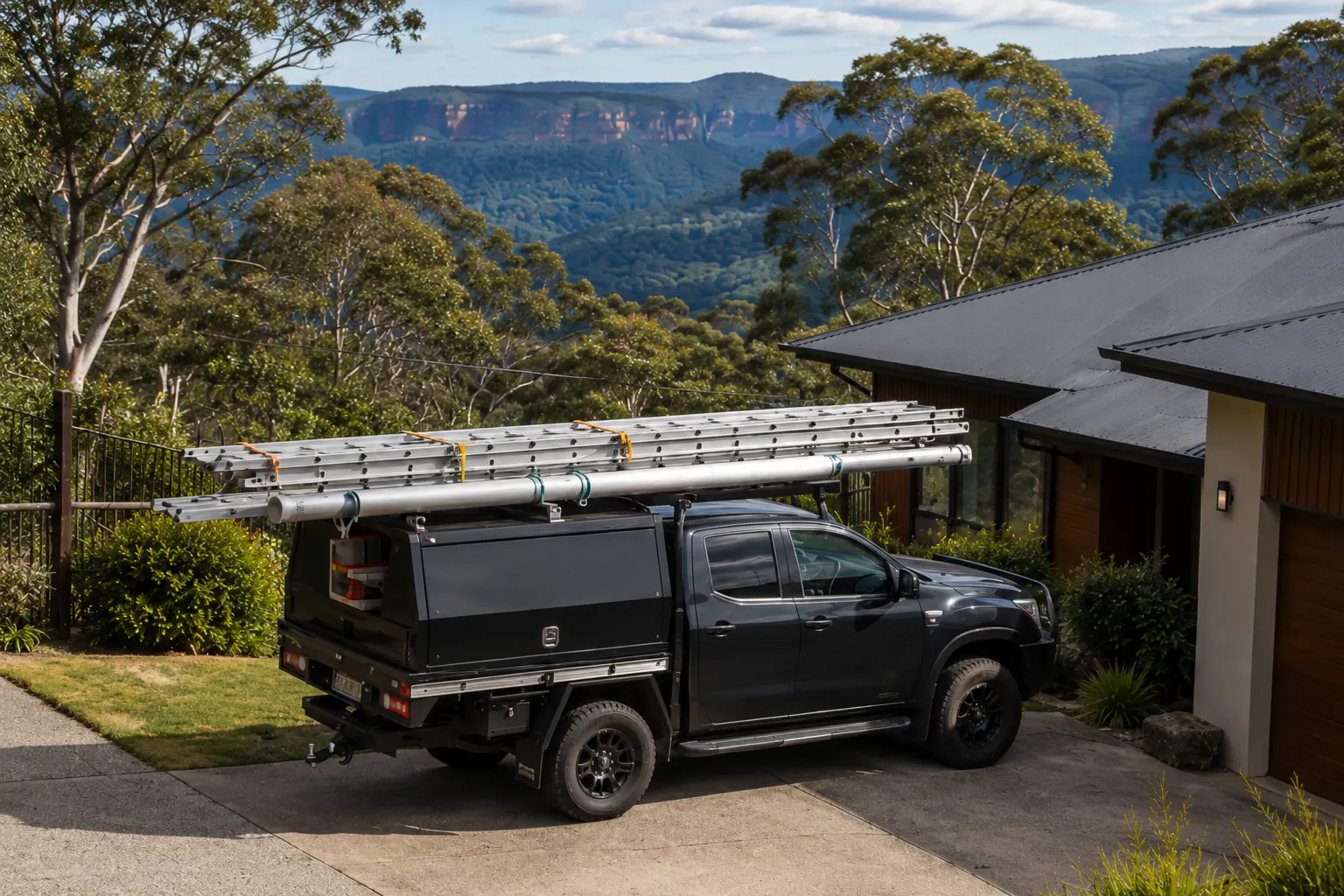
The failure pattern here is different from the western plains, and it is worth knowing because it changes what you look for.
Branch strike. By far the most common. Mature eucalypts, saturated ground, and wind. A limb does not have to be large to break tiles, bend a valley iron or punch through sheeting, and Woodford has gums standing over 70 metres. Blocks backing onto national park at Winmalee, Faulconbridge and Mount Riverview see it most.
Wind lift. Westerly weather across an exposed ridge finds whatever is already loose: rocking ridge caps on failed pointing, old sheeting with tired fixings, barge and flashing edges. The roof does not fail where it is sound; it fails where it was already overdue.
Driven water. Persistent rain plus fog means roofs here stay wet for days rather than hours. Water that would run off a coastal roof has time to find its way through a cracked flashing or a lazy sheet lap. The leak appears in a storm, but the fault was there beforehand.
Falling debris and ember load during fire weather. Different hazard, same roofline. Blocked gutters and open roof details are the part of the building most worth having in order before a bad fire-weather day.
Once the roof is dry enough to work on properly, the permanent fix gets scoped and quoted in writing. Depending on what the storm exposed, that might be:
Storms tend to reveal rather than create. A roof that loses half a ridge line in one night usually had nothing holding that ridge line on.
We document, we do not advocate. What that means in practice: we photograph the damage before and after make-safe, write up what we found and what caused it where it can be determined, and provide an itemised scope and quote in the form insurers normally want. If your insurer or assessor wants a standalone written report, a roof inspection and report covers that.
What we will not do is tell you your claim will be approved, or inflate a scope to suit a claim. The decision sits with your insurer.
Honest expectation setting. The settlements run in a single line along the Great Western Highway and the railway, so when the highway is affected there is no alternative route for much of the ridge. Fog can cut visibility to very little at altitude, driveways on steep blocks are often unsealed and slippery when wet, and after a widespread weather event every roofer on the mountains is working through a queue.
Which is why the earlier you ring, the better. (02) 4703 5000.
Most of the emergency work we do was preventable twelve months earlier. Clearing gutters and valleys before storm season, repointing a ridge that has started to crumble, and cutting back the limbs directly over your roof are three cheap things that prevent expensive nights. If you want it assessed before anything happens, the inspection and the written quote are free either way.
Work is carried out by established, licensed and insured roofing contractors working to NSW Fair Trading requirements, and completed repairs carry a written workmanship warranty.
Turn off power to that part of the house at the switchboard if the ceiling is wet near lights or fittings, move what you can out from under it, and put a container down. If the plaster is bulging with trapped water, a single small hole at the lowest point lets it drain in one place instead of bringing the sheet down. Then ring us on (02) 4703 5000 and stay off the roof yourself.
It will if it is fixed rather than weighted. A tarp held down with bricks is gone by morning in a westerly. A proper make-safe is mechanically fixed with battens over the membrane and the edges turned and secured so wind cannot get underneath and peel it. On a steep pitch that is slower and more awkward to do, which is exactly why it has to be done properly the first time.
Make-safe, carefully and with the right gear. Permanent work, generally not. A wet roof at altitude is a serious slip risk and nothing cures on a surface sitting in fog. So the realistic sequence in bad weather is stop the water now, then come back for the proper repair in a dry window. We will be straight with you about which part of that we can do today.
Yes, if it is safe to do so from the ground or a window. Date-stamped photos of the damage, of anything that came off, and of the interior water damage are useful to an insurer. We also document what we find and what we do during the make-safe and give that to you. What happens with a claim is between you and your insurer, and we will not predict an outcome.
Mostly not. The dominant cause up here is falling limbs off mature eucalypts in wet, windy weather, followed by wind lifting old sheeting and ridge caps that were already loose. Water driven sideways in persistent rain and fog is the third. Hail happens, but it is not the main reason we get called out to a mountains roof.
Tell us what you need and we'll get straight back to you. Prefer to talk? Call (02) 4703 5000 and speak to someone local.
Call (02) 4703 5000